

Introduction
What if water could respond to words, emotions, or music?
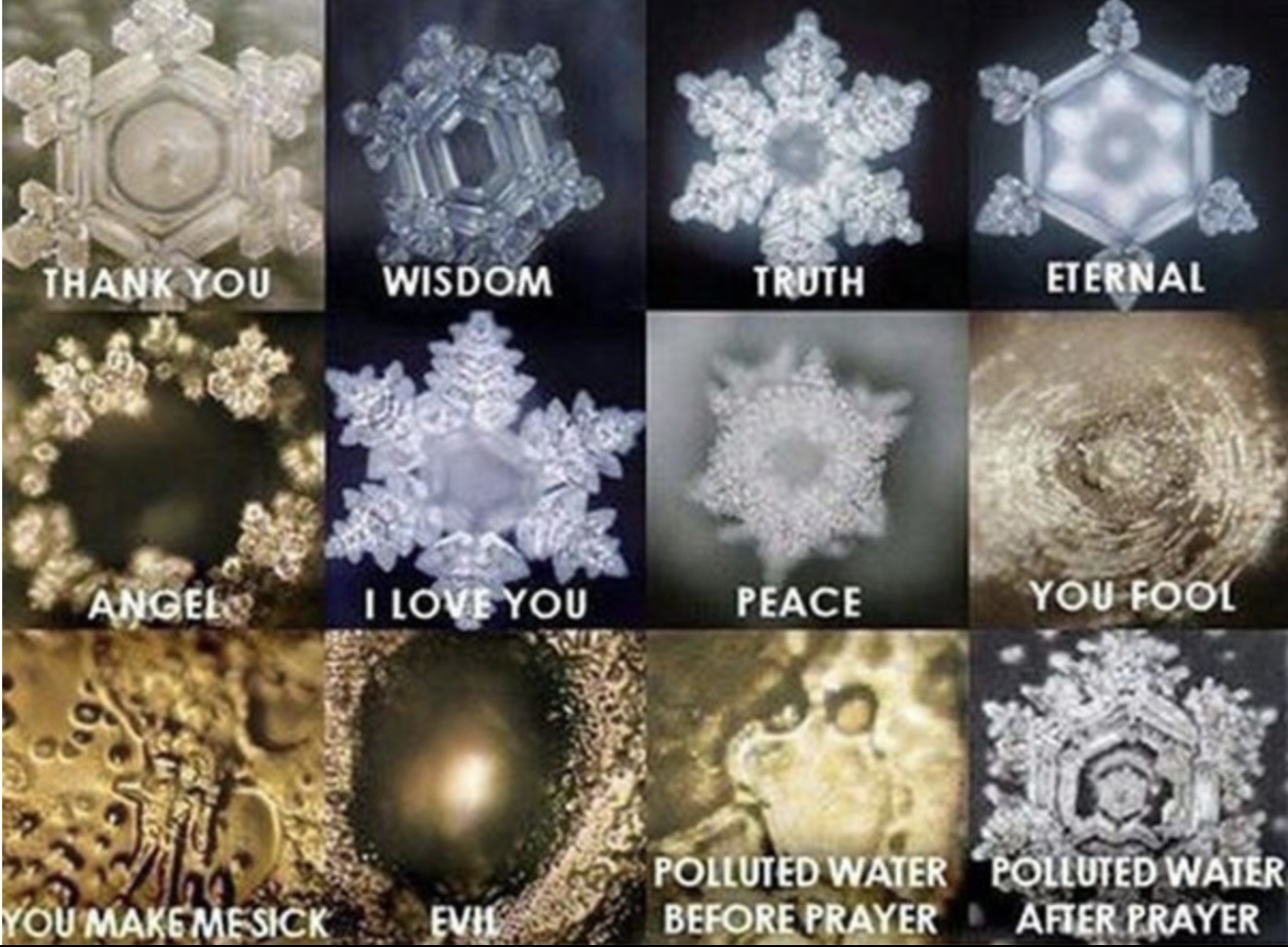
This idea became widely known through the work of Dr. Masaru Emoto, a Japanese researcher who photographed frozen water crystals after exposing water to different environmental influences.
His images appeared to show something fascinating:
Water exposed to positive words or harmonious music formed symmetrical, beautiful crystals.
Water exposed to harsh words appeared disorganized or fragmented.
The concept captured global attention because the human body is largely composed of water. If water responds to frequency, what could that mean for us?
Let’s explore what this research suggests — and what it does not.
Dr. Masaru Emoto was a Japanese author and researcher best known for his book The Hidden Messages in Water.
He proposed that water can respond to:
- Words
- Intentions
- Emotions
- Music
- Environmental frequencies
His method involved freezing treated water samples and photographing the resulting ice crystals under a microscope.
He reported that:
- Words like “love” or “gratitude” produced symmetrical crystalline structures
- Words like “hate” or “anger” produced irregular patterns
These images sparked both inspiration and scientific debate.
What Does “Frequency” Mean in This Context?
Frequency simply refers to vibration.
Everything in nature vibrates at measurable rates:
- Sound waves
- Light waves
- Electrical signals
- Molecular motion
Even spoken words create sound waves — measurable physical vibrations that travel through air and can interact with matter.
In physics, structured vibration can influence physical organization. For example, cymatics experiments show how sound frequencies shape patterns in sand or water.
The broader idea is this:
If water molecules can organize differently under varying energetic conditions, then vibration may influence structure.
What Does Mainstream Science Say?
It’s important to clarify:
Dr. Emoto’s work has been widely criticized for lacking strict experimental controls and reproducibility.
His studies were not consistently conducted under blinded scientific conditions, and many scientists argue that the results may have been influenced by selection bias.
As of now:
- The idea that human intention directly alters water structure remains unproven in mainstream research.
- There is no widely accepted scientific consensus supporting these claims.
However, the broader field of bioelectricity and molecular signaling does confirm that:
- Water structure can change under temperature, pressure, and electromagnetic conditions.
- Biological systems are sensitive to electrical and vibrational inputs.
The conversation continues, but it remains an area of emerging exploration rather than established fact.
Why the Idea Resonates
Even with scientific controversy, the concept resonates deeply for several reasons:
- The human body is approximately 60% water.
- Sound and vibration clearly affect biological systems (for example, through music therapy and nervous system regulation).
- Emotional states measurably influence heart rhythm and nervous system coherence.
Research in psychophysiology suggests that emotional states are associated with changes in heart rate variability and autonomic nervous system function. These are measurable electrical patterns.
This does not prove that thoughts directly restructure water crystals in the body.
But it does support the idea that:
Biology is sensitive to vibration.
A Broader Perspective on Frequencies
When discussing frequencies in health, it is helpful to separate three layers:
- Established Science
- Electrical signaling in nerves
- Electromagnetic fields generated by the heart and brain
- Sound waves affecting matter (cymatics)
- Emerging Research
- Cellular bioelectric signaling
- Effects of electromagnetic exposure on biological tissues
- Water structuring under physical conditions
- Hypothesis & Interpretation
- Conscious intention restructuring water
- Emotional imprinting of molecules
Dr. Emoto’s work largely sits in the third category.
It invites curiosity — but requires critical thinking.
What Can We Take Away?
Regardless of the controversy, one principle remains grounded in science:
The body is responsive to environment.
- Stress changes electrical patterns in the nervous system
- Sound influences mood and physiology
- Coherent breathing affects heart rhythm
- Light influences hormonal cycles
Whether or not water crystals respond directly to words, your biology absolutely responds to:
- Tone
- Emotional environment
- Nervous system regulation
- External stimuli
And that is measurable.
Conclusion
Dr. Masaru Emoto’s research opened a conversation about vibration, intention, and water.
His images sparked imagination and invited us to look beyond purely chemical explanations of life.
While his conclusions remain debated, the larger insight remains valuable:
Biological systems are dynamic, responsive, and influenced by their environment.
The deeper question may not be:
“Can water hear words?”
But rather:
How does vibration — physical, emotional, electrical — influence living systems?
And how can we use that understanding responsibly?
That is a much larger topic… and one worth exploring further.
A Personal Reflection: A Classroom Experiment
A few years ago, when my daughter Alia was in third grade, my husband and I shared Dr. Emoto’s work with her teacher. The class decided to create a small experiment inspired by his ideas.
It was simple.
Three glass jars.
Cooked rice.
Water.
Two weeks near a window.
The jars were labeled:
- “I love you.”
- “I hate you.”
- “Ignored.”
Each day, the children spoke to the jars.
One jar received kind words.
One received harsh words.
The third was deliberately ignored.
At the end of the experiment, something interesting happened.
The “I love you” jar remained lighter and relatively clear.
The “I hate you” jar developed a dark, mold-like environment.
The “Ignored” jar dried out and appeared old and stagnant.
Was this a perfectly controlled scientific study? No.
But it created a powerful moment of observation and reflection for the children.
The real lesson wasn’t about proving molecular restructuring.
It was about awareness.
Words carry tone.
Tone carries vibration.
And environments influence outcomes.
Whether through biochemistry, nervous system signaling, or environmental factors, we know that living systems respond to conditions around them.
That classroom experiment left a lasting impression — not because it “proved” something — but because it invited curiosity.
Closing Reflection
If biology is electrical…
If biology is responsive…
If biology adapts to its environment…
Then perhaps the deeper question becomes:
How do our daily words, stress levels, and emotional environments influence the systems we live in — and the bodies we live inside?
That is where this conversation continues.